Crafting Change
Local brewers discuss current trends and future industry potential.
Despite an economically disruptive pandemic and lingering supply chain challenges, beer still is booming in Reno-Tahoe and beyond.
American craft brewer volume sales grew 8 percent in 2021, according to the Brewers Association, a national organization, while retail sales increased 21 percent to $26.8 billion. This means independent brewers now account for roughly 27 percent of the $100.2 billion-valued American beer market. By the end of 2021, the United States was home to 9,247 breweries, up 2.5 percent from 2020 and a staggering 310 percent increase from 2,252 in 2011.
“The number of breweries has continued to skyrocket. If you look at the local growth, it pretty much follows that trend,” says Matt Johnson, co-founder of IMBĪB Custom Brews in Reno and Sparks. “There’s not a ton of room for new competition, and so you’re now seeing trends start to turn the other way … and you’re also seeing some consolidation.”
Johnson points to this summer’s acquisition of Stone Brewing, a mainstay in the California craft beer market since 1996, by Japanese brewery Sapporo, for a reported $165 million, as one of the more significant recent examples.
Locally, notable deals include the merger of Reno’s Lead Dog Brewing in 2021 with Mammoth Brewing Co., and restaurateur Mark Estee’s acquisition of Nevada’s oldest brewery, Sparks-based Great Basin Brewing Co., which has a spot in Reno and expanded to a third location in Carson City this spring.
These examples of local growth underscore a trend accelerated by the pandemic: Demand for craft products is growing, but that doesn’t mean Reno-Tahoe will see a rapid influx in breweries — and that’s a good thing, notes Brandon Wright, co-founder and brewmaster/distiller at The Depot Craft Brewery Distillery in Reno.
“Ten to 15 years from now, you may still only have eight or 10 main breweries in town, which per capita is still a good amount,” he says. “But what I think you’ll see is they’ll be producing a surprising volume of beer relative to what they’re doing now.”

Local Growth and Expansion
Per the Brewers Association, Nevada is home to 51 craft breweries as of 2021, a 183 percent increase from 18 in 2011. Those businesses contributed an economic impact last year of roughly $528 million.
Regionally, several breweries have launched in the last two years alone, notably Record Street Brewing in 2020 in the burgeoning Brewery District on Fourth Street in Reno. Elsewhere, Bear Belly Brewing (Kings Beach) and Donner Creek Brewing (Truckee) launched in 2020, while Three Sheets Brewing opened last year in Tahoe City.
And at least two more fresh faces are on tap for Reno: Slieve Brewing Co. is slated to open this year next to Pigeon Head Brewery, while O’Neill Beer Co. plans to open next to 10 Torr Distilling and Brewing.
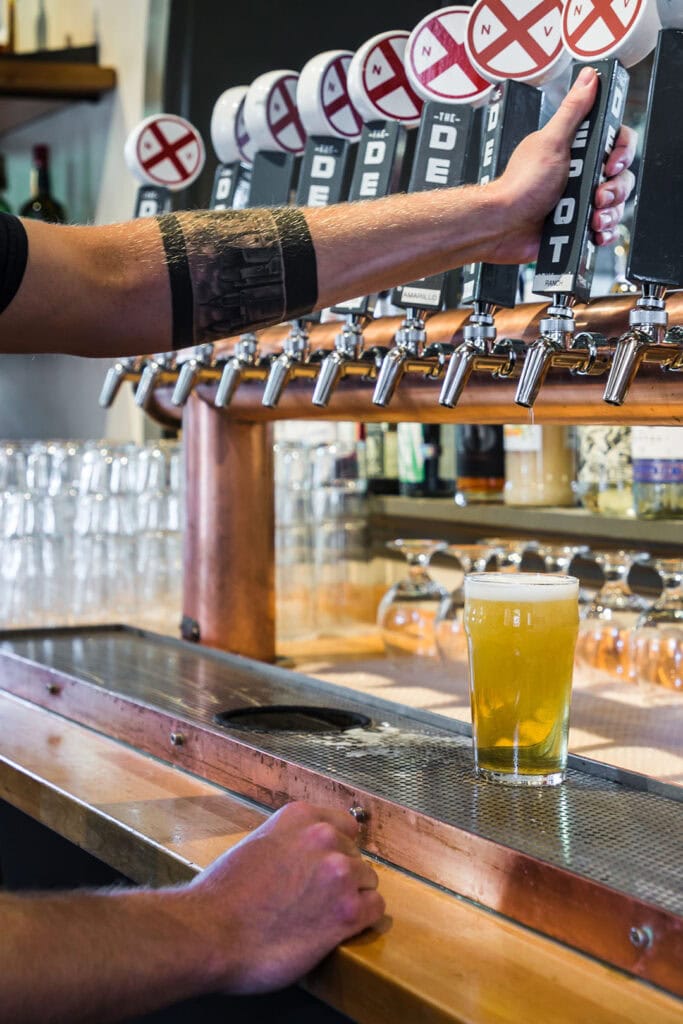
Other established brands have been or are expanding, including Carson City’s Shoe Tree Brewing Co. into a second branch in Minden last year, and Truckee’s FiftyFifty Brewing Co., with its new brewpub opening this year at the revitalized Reno Public Market.
More expansion may be on the horizon at IMBĪB, which launched on Second Street in Reno in 2015 and expanded to include a taproom in Sparks at The Outlets at Legends in late 2019.
“We’re looking at opening a third location somewhere,” says Johnson, a past president of the Nevada Craft Brewers Association. “It may not be Reno-Sparks, it could be Carson, could be Incline, could be South Lake … but I believe we can do well having a third taproom because our profit margin is so much better on direct-to-consumer sales versus trying to sell a keg to a distributor at our scale.”
State of the IPA
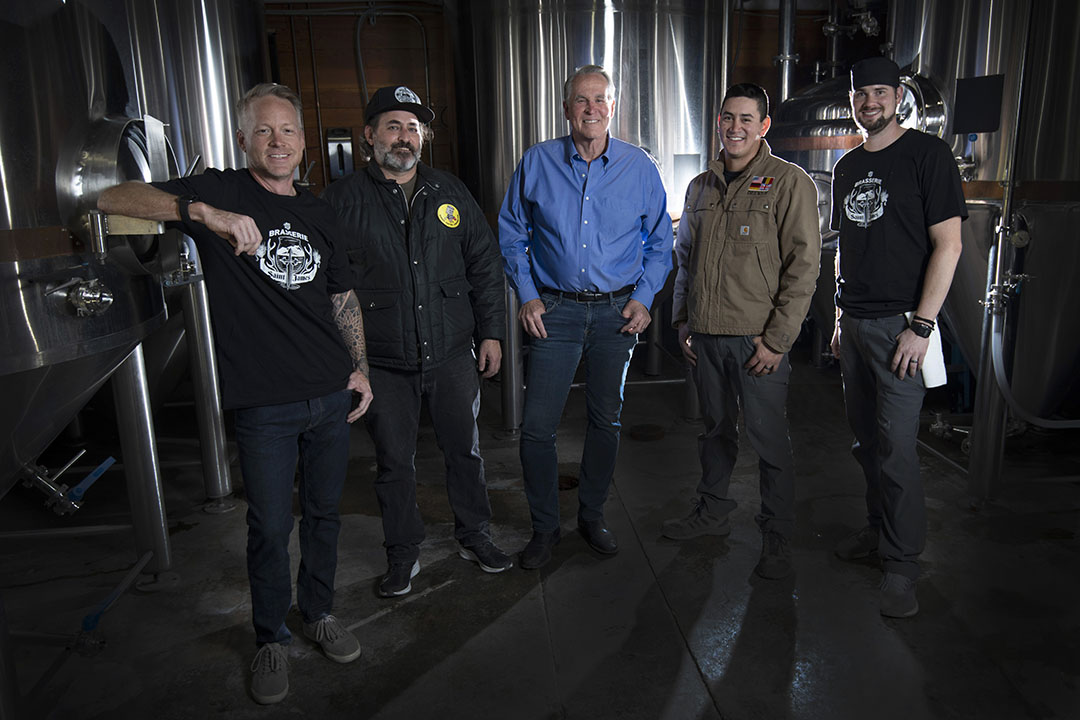
Brasserie Saint James represents another recent upgrade to the local brewing scene. A revitalized version of the Midtown brewpub established in 2012 reopened on New Year’s Day 2021, thanks to significant financial investments from owners Deane Albright and Joel Rasmus.
Brewmaster Madison Gurries points to ever-evolving trends in what people are drinking as a major industry shift over the past decade.
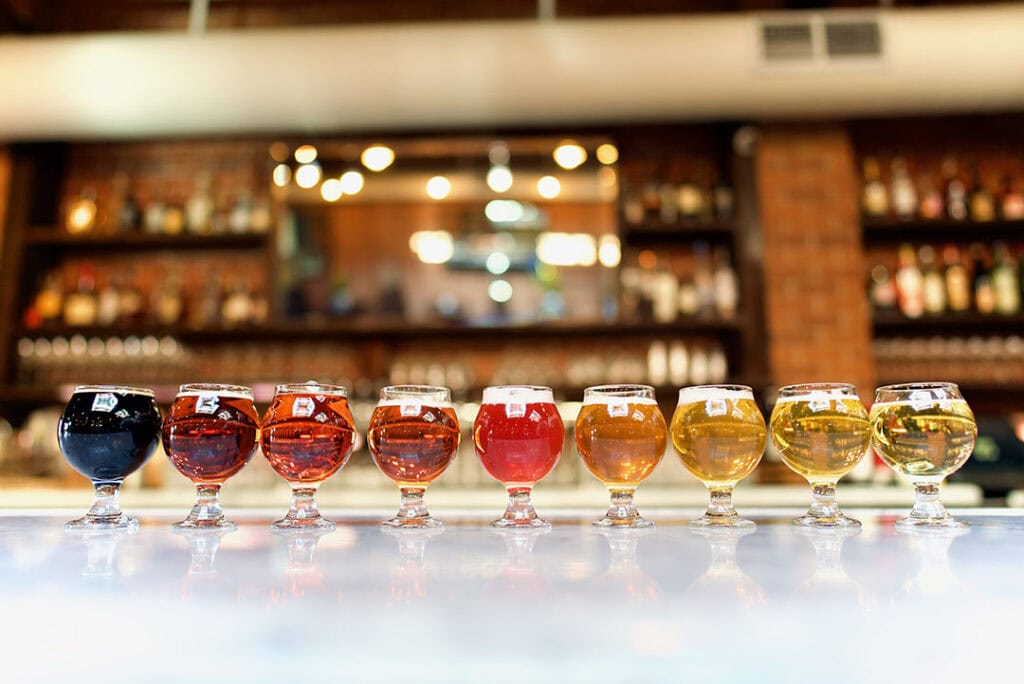
“Beer styles and trends, they come in hot and sometimes they last, and sometimes they do not,” Gurries says. “When we started, goses were big, and we built our name mostly off our Belgian beers and saisons, but those are a lot harder to sell to the market now than they used to be.
“Take hazy IPAs, for example. They weren’t that big four years ago, but now, even I have four hazy IPAs on tap,” he says.
To that end, while more consumers these days are expressing concern on social media and at craft beer events about the proliferation of IPAs, don’t expect them to go away any time soon.
“People ask me, “Why do you guys keep making IPAs?’ Well, I’ll stop making IPAs when people stop buying them. They’re still all in the top of our best sellers. The market wants what it wants,” Gurries says. “Is there a breaking point with IPAs? I don’t think so, because now there’s a new craze of cold IPAs that’s hitting hard right now. That’s just the next wave of IPAs, and I think there will be waves of IPAs coming in for a while … because IPA sells.”
Wright agrees, saying that while “it’s incredibly difficult to look into the crystal ball and predict the trajectory and future interest of the beer market,” IPAs aren’t any more of a fad than pilsners.
“If you look at the Great American Beer Festival last year, the biggest category of entries from commercial breweries was hazy IPAs,” Johnson adds. “Nobody could have predicted that, even four years ago.”
Smoked Beers and Other Experiments
That’s not to say breweries aren’t constantly testing new styles, whether reimagined sours, cold IPAs, or something completely different, such as smoked beers, which have found their way onto IMBĪB’s menu in recent months.
“Smoked beers are kind of a love-hate thing, but we have been heartened to see how many people try those and actually enjoy them,” he says. “They’re very gently smoked; it’s not in your face, and they’re lighter beers, about 4 percent ABV. That’s also a huge trend right now. A lot of young folks are looking for lower-calorie, lower-alcohol products, but they want something that’s interesting and flavorful, so we’re toying with smoked beers. I’m not saying it’s going to be a trend, but it’s nice to see that they’re selling for us.”
Of course, not all experiments work out, something Wright reflects on with a few sarcastic chuckles.
“We talk about beers with staying power like IPAs and sours, but I’m proud to say I’ve been around beer long enough to remember our greatest bloopers,” he recalls. “An all-time favorite was 15 or so years ago. Every home-brew magazine I picked up was about Cascadian Dark Ales, the black IPA. For a good six months to a year, it was buzzing all around town. Everyone was trying to craft the perfect CDA, and all these brewers were playing mad scientist trying to get the bitterness just right because ‘this was the future of IPAs.’ Within 14 months, you couldn’t give CDAs away. That’s one of our bloopers as a craft community. It lasted less time than I could even go through the hops.”
Kevin MacMillan is a Reno-based writer/editor whose favorite beers are IPAs — the hoppier, the better.
RESOURCES
Brasserie Saint James Brasseriesaintjames.com
IMBĪB Custom Brews Imbibreno.com
The Depot Craft Brewery Distillery Thedepotreno.com
New To the Scene?
One of the biggest factors working in the industry’s favor is the influx of new consumers each year as they mature into drinking age. So how would each brewer craft the perfect lineup of tastes for someone looking to buy their first-ever flight?
Johnson: “I would absolutely start with a light lager, then probably throw a hazy IPA in there because those tend to be the most approachable IPAs. Then we’re going to throw a sour beer at you because we want to challenge your palate. It doesn’t mean you’re going to love it, but we want people to see what that’s like. And then probably a barrel-aged beer. Those are kind of the four trends right now.”
Wright: “If I’m trying to broach this with an adult who says they’re not a beer drinker but a wine drinker, I can talk about what varietals they enjoy, and then I can curate a flight. If it’s a big cab drinker who likes the robustness and tannin of a cab, I can steer them in the direction of a Flemish red ale or a Belgian sour style. If they’re more of a buttery chardonnay drinker, I might try a Belgian blonde ale. You can really run the gamut.”
Gurries: “If we’re going full range, full spectrum, you can start with something really light that’s not hoppy, like a German helles. From there, you can go the IPA route and teach them about hops; then you can go into a darker beer and teach them about malt; then you go into the sour, funky realm and teach them about yeast and bacteria. There are four ingredients in beer — water, malt, hops, yeast — so that way, you showcase all four.”
More From This Issue
Celebrating Chestnuts
Chestnuts roasting on an open fire? How passé. It’s an endearing holiday song, indeed, yet seasonally incorrect when speaking of the…Beeline to Berkeley
Yearning for a getaway full of delicious dishes and drinks? Make a beeline to Berkeley.Conservation Advocates
Sportsmen. Huntsmen. They’re terms that have been used for centuries, but they need some updating. After all, when it comes…