Fruit Forward
Discover the Monument to Sharing at Nevada Museum of Art.
Within Reno’s urban center, a botanical wonderland has emerged. A trip to the Nevada Museum of Art can transport visitors into what could be a Lewis Carroll novel, replete with towering flora and fauna, and a sculpture garden that, though lacking a sign stating, “Eat me” (as Alice encountered), is intended for just that purpose.
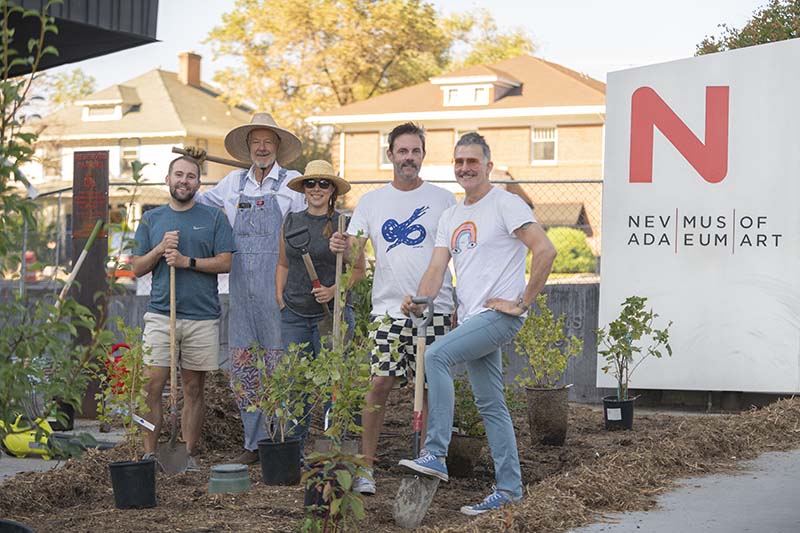
In 2022, Monument to Sharing began as a living installation of fruit-bearing flora in the Linda and Alvaro Pascotto Sculpture Garden outside the museum. Conceived by David Allen Burns and Reno native Austin Young as part of their collaborative, the Los Angeles-born Fallen Fruit project, Monument to Sharing is an immersive installation in the form of an edible public sculpture garden producing fruit and herbs meant to be harvested by and shared with the community.
In addition to the Nevada Museum of Art installation, Fallen Fruit has a multitude of fruit-tree exhibitions installed around the world, which Burns and Young explain were planted “as an artwork for sharing.” Additionally, the collaborative’s Endless Orchard initiative is an online portal that maps publicly available fruit trees in several countries.
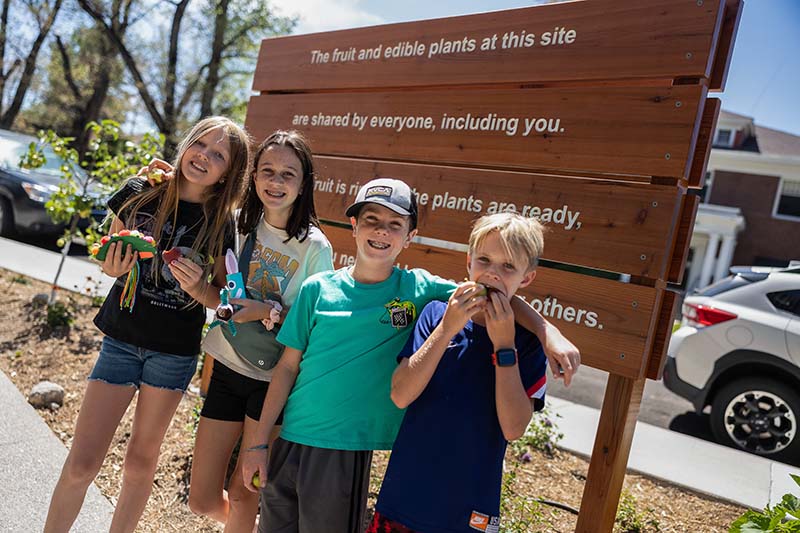
“Our intention has always been to create a community around shared resources and bridge relationships with accessible fruit trees planted around a neighborhood. We think of it as an artwork that, at its core, is about sharing,” Young says. “We like to think that generosity begets generosity. It also stems from our own love of finding fruit on walks, for example picking blackberries or plums on the side of a road.”
Beyond the Still Life
Fruit has long served as artistic inspiration. Fallen Fruit amplifies this idea by planting living fruit trees that naturally bloom into eye-catching art, often in areas where fruit trees are scarcely seen or even may be illegal. For example, its first public artwork, Del Aire Public Fruit Park, commissioned by Los Angeles County in 2012, helped change public policy in an area where fruit trees were banned from public spaces and parks.
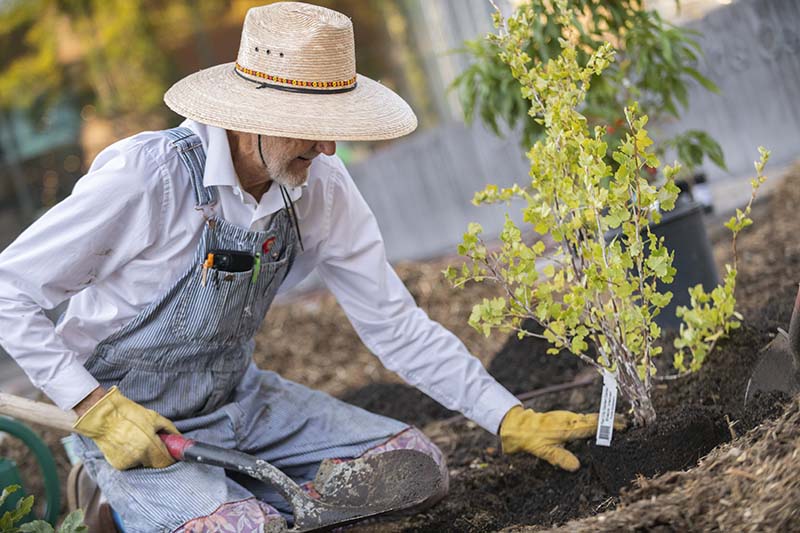
When the Nevada Museum of Art staff sought to install a new sculpture garden, it determined that Fallen Fruit’s use of generosity, public gardens, collaboration, and other aspects of civic participation meshed with the museum’s ongoing mission to be a foundational resource for the community, explains Apsara DiQuinzio, the museum’s senior curator for contemporary art.
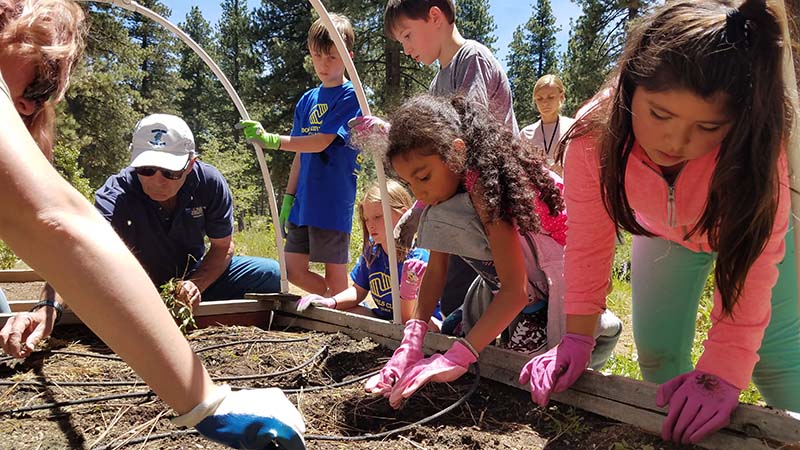
Tended to regularly by museum volunteers, Monument to Sharing was designed by Burns and Young, then planted using climate-friendly and native botanicals, with local horticulture expertise from Tom Stille of Interpretive Gardens Inc. in Reno, who continues to help maintain the garden.
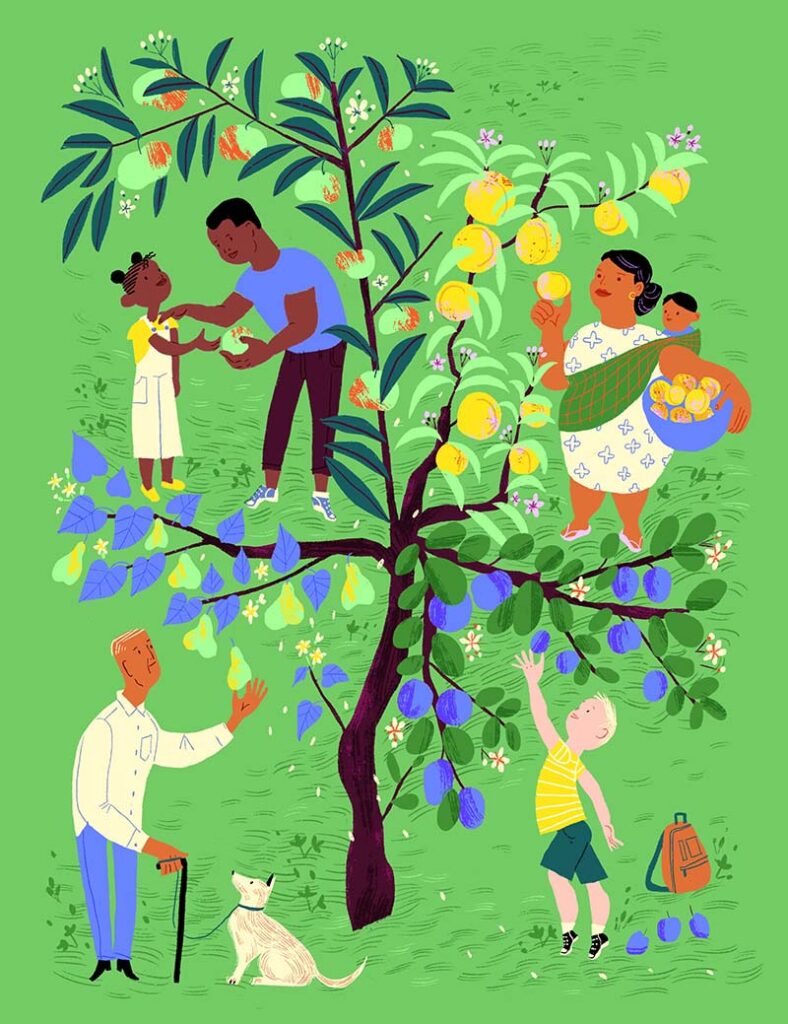
The permanent installation comprises 21 indigenous or naturalized, fruit-bearing trees selected for their geographical and cultural importance, including peach, plum, pear, cherry, and apple. A berry patch, grapevines, herbs, and some “volunteer” growth, as DiQuinzio calls it, that have since appeared complement the trees.
“We think our cities can — and should — be like communal gardens. By reimagining public spaces, we want to make fresh fruit available to everyone,” Burns says. “Unfortunately, many city codes are antiquated, and rather than allowing fruit trees to be planted along city streets, they instead require ornamental trees that often don’t benefit pollinators or people. We want to change that.”
Bringing the Outdoors In
In September 2024, the Nevada Museum of Art’s Donald W. Reynolds Grand Hall transformed into a soaring garden setting when The Power of Pollinators (And Other Living Things) was installed. Created for the museum by Burns and Young as an exhibit that would work in tandem with Monument to Sharing yet stand on its own, it was inspired by Northern Nevada’s native flora and fauna. Their original artwork on vibrant, cascading drapery and expansive wallcoverings spans the walls from floor to ceiling in the atrium.
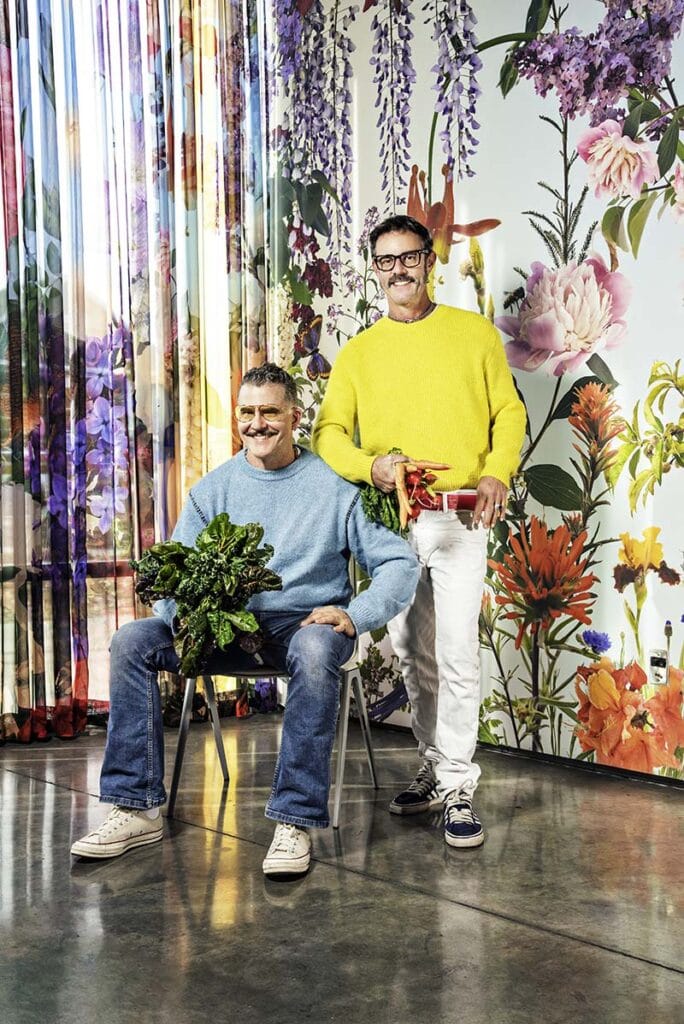
“The animals depicted are those that can be found in neighborhoods, the foothills, and in the Sierra. We identified the flora by walking around BLM land, public parks, and neighborhoods,” Burns explains. “Many of us who live in cities don’t appreciate the wide biodiversity that surrounds us in our own neighborhoods. We think of it as a portrait of the Great Basin.”
Entering the installation, it feels as if you’ve somehow morphed into an ant meandering through an immense garden tableau.
“I think it’s a really inviting, beautiful space that visitors encounter when they first walk into the museum now, which highlights the importance of our relationship to the natural world,” DiQuinzio says. “In using flora and fauna that are specific to Reno in the installation, it highlights the nonhuman and human life that surrounds the museum and that we are a part of, and it helps to bring that relationship to the foreground.”
Naturally Collaborative
Both Fallen Fruit exhibits are collaborative endeavors that, DiQuinzio explains, involve all the museum’s domains. Volunteers and docents help maintain the garden, the artists work with the museum’s education department to host public programs based on their work, and merchandise based on The Power of Pollinators (And Other Living Things) is available for sale in the museum gift shop.
In 2026, Fallen Fruit will cohost the Endless Orchard Fruit Tree Adoption program with the museum, in which local residents or organizations adopt and plant trees on their private property, in a place that’s publicly accessible, and agree to share the trees’ fruit with the community and be added to Fallen Fruit’s Endless Orchard map of Reno.
“Every day there are animals, plants, and insects making our neighborhoods more abundant and beautiful. The artworks together speak to our communal and interdependent relationship to the natural world,” Young says. “Even cities and suburbs are teeming with life and abundance. Our world is for sharing, and it’s not always about people, cars, and cellphones.”
Nevada Museum of Art’s New Addition Opens This Spring
In 2022, the Nevada Museum of Art embarked on an expansion project to add 50,000 square feet to its Northern Nevada footprint. Early 2025 saw the realization of this $48 million addition that doubles the museum’s gallery space square footage, so more of its permanent collection can be displayed year-round. It also boasts a new education and research center to serve students, scholars, and the community, among other improvements.
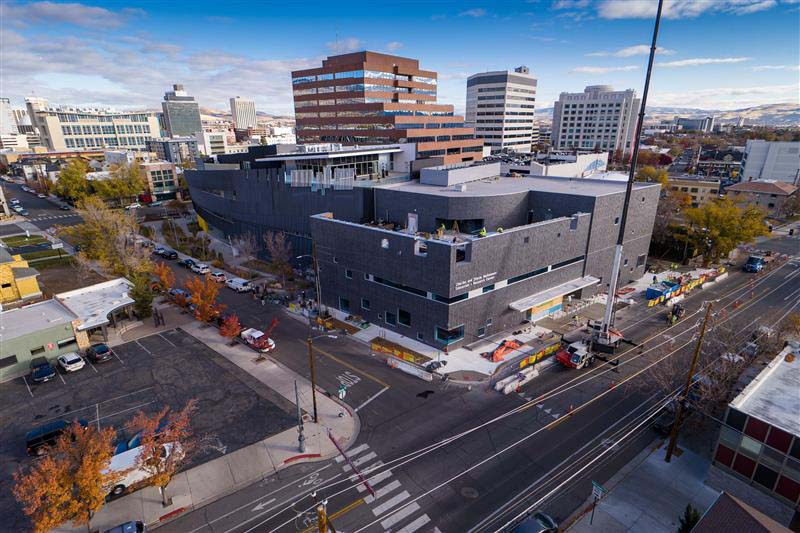
“The Charles and Stacie Mathewson Education and Research Center will increase access to the museum’s extensive art, archive, and library collections while doubling capacity to serve pre-K to 12th grade students, educators participating in professional development, and scholars undertaking academic research,” says Chief Operating Officer and Deputy Director Amy Oppio.
Additional parking, energy-efficient building upgrades, a new bookshop, an area for storage and conservation of art collections, and a third-floor sculpture garden also have been added.
Expansion plans have been brewing since 2017, when the museum embarked on a budget analysis and initial architectural concepts. Those plans eventually were approved by the Board of Trustees in 2019, and phased remodeling and construction began in 2022.
“Despite a population of 3 million, Nevada only has one accredited art museum to serve its citizens. As such, we have both urgent and ongoing needs that must be addressed to accommodate the education and research programs that benefit the state’s rapidly growing population,” Oppio explains. Opening exhibitions and events are scheduled throughout 2025. Lynn Hershman Leeson: Of Humans, Cyborgs, and AI plus The Art of Judith Lowry are among the first exhibitions scheduled for the new galleries and both can be viewed this spring.
More From This Issue
The Last Bite
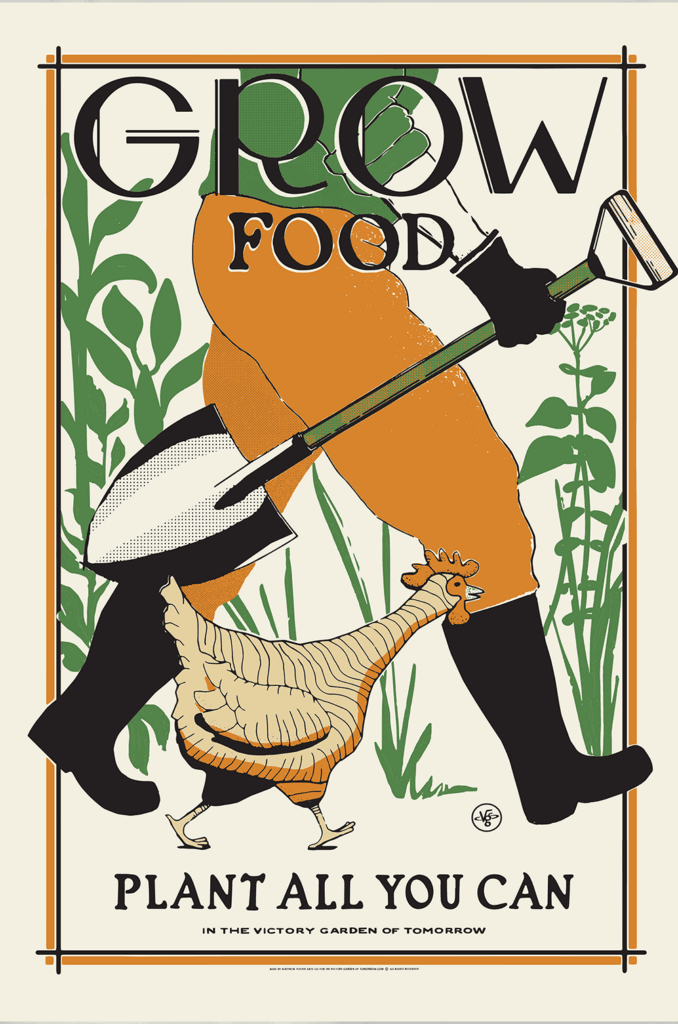
Grow food, plant all you can in the victory garden of tomorrow.Why Worry About Wasted Food?
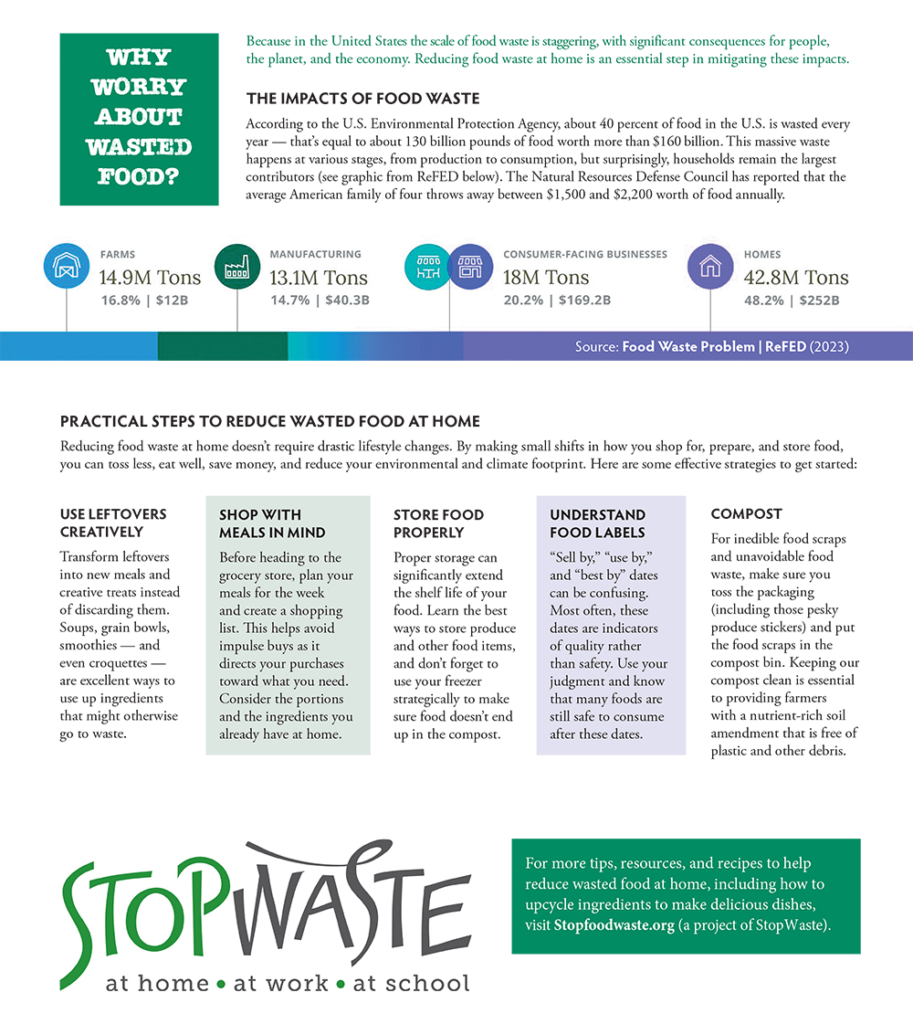
Because in the United States the scale of food waste is staggering, with significant consequences for people, the planet, and…