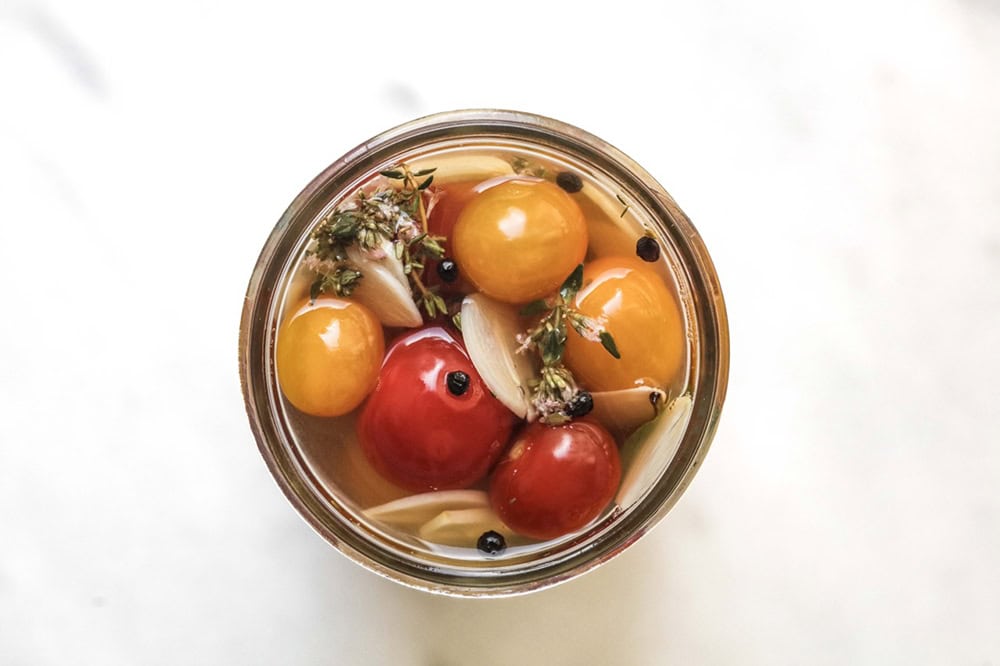
You Can Pickle That!
Go beyond cukes and pickle all sorts of seasonal produce.
This story first appeared in the summer 2024 edition of edible Ohio Valley
It’s maybe the funniest sketch of the extremely funny sketch comedy show Portlandia: Bryce Shivers and Lisa Eversman (played for ironic earnestness by Fred Armisen and Carrie Brownstein) say “Everything should be pickled” — as they proceed to pickle literally everything, including worn Band-Aids, plastic CD jewel cases, traffic tickets, a broken shoe heel …
Now, we’re not suggesting that you pickle noncomestibles. We are suggesting, however, that you take the opportunity to pickle stuff you haven’t pickled before.
Peaches, plums, and nectarines? Yep, you can pickle those. Cherry tomatoes? Aces. Peppers and carrots and corn and zucchini? You betcha.
All About That Brine
We’re talking about quick pickling, which is a super easy technique that involves pouring hot brine over fresh fruits or veggies in a pint or quart canning jar. Brine is simply a mixture of vinegar and water, but the magic really happens when you add flavorings.
Here’s a quick formula to yield 2 pints of pickled whatever:
1 pound fresh produce + 1 cup vinegar + 1 cup water + 1 tablespoon sugar + 1 tablespoon kosher salt
So let’s work through the formula:
Produce can be just about anything that’s in season. Scallions, asparagus, Swiss chard stems, ramps, rhubarb, and strawberries in spring. Cherry tomatoes, zucchini, carrots, corn, peppers of all types, stone fruits, beets, and onions in summer. In fall, try apples, cauliflower, cabbage, turnips, or Brussels sprouts. Wash and trim the produce, and select items that are blemish free and slightly underripe to ripe.
Choose a vinegar whose flavor profile fits the produce. For milder-tasting veg or fruit, Champagne, rice wine, or a lightly sweet apple cider vinegar works well; for firmer vegetables or when you want a bolder flavor, think about stronger-tasting vinegars such as red wine or a pungent apple cider vinegar. You can do a 1:1 vinegar-water ratio or reduce the amount of water to enhance the vinegar taste.
Sugar and salt are a matter of preference; I prefer a tad more sugar than salt, more like 2:1 or even 3:1 (in other words, 3 tablespoons sugar to 1 tablespoon salt). You can take a quick taste of the warm brine and add sugar or salt and then reheat to dissolve it.
Add Lots of Flavor
Here’s where you can really get creative. Think about the flavor profile you want the pickles to have: fresh and herby, spicy, sweet and tangy, garlicky.
If you’re using spices in seed form (mustard, cumin, coriander, fennel, peppercorns), toast them lightly in a dry saucepan to bring out their flavors before adding the water and vinegar and making the brine. Whole cloves, star anise, and cinnamon sticks are great for pickling fruit. Garlic cloves, onion or scallion, and slices of fresh ginger are great additions. Go for fresh herbs such as tarragon, dill, or thyme (basil tends to go limp and sad in a pickle jar). If you’re serving the pickles directly from the jar, you always can replace the original herb sprigs with fresh ones for appearance.
Place your vegetables or fruits and fresh flavorings (herbs, garlic, etc.) in the jars, and then pour in the hot brine to cover, leaving about a half inch of headspace. Cover the jars, let them cool to room temperature, and then refrigerate for a day or two to develop the flavors before eating contents.
Keep It Clean
A note of clarification: Quick pickles are meant to be consumed in a couple of weeks, up to a month, and they’re stored in the refrigerator. They’re not water-bath processed for long preservation. Still, it’s smart to start with sterilized jars and lids. Place the jars and lids in the sink and liberally pour boiling water over them. Let them cool before filling.

Ingredients
- 2 cups sugar
- 1 cup white vinegar
- 2 3-inch cinnamon sticks
- 8 whole cloves
- 2 star anise
- 2 pounds fresh peaches peeled, pitted, and sliced
Instructions
- Pour sugar and vinegar into a large saucepan, and stir to dissolve sugar. Add cinnamon sticks, cloves, and star anise; and bring to a boil for about 5 minutes. Remove spices and set aside.
- Divide peaches between 2 or 3 sterilized 1-pint canning jars. Fill each jar (leaving ½ inch of headspace) with hot pickling liquid, dividing spices and tarragon sprigs evenly among the jars. Cover jars with new lids and bands.
- Let cool to room temperature. Refrigerate for at least 1 day for flavors to develop; keep for up to 1 month refrigerated.
- Or, process still-hot jars in a water bath canner according to directions found at Freshpreserving.com.

Ingredients
- 1 cup strawberries washed and hulled (halved if large)
- 1 teaspoon whole black peppercorns
- 2 sprigs fresh tarragon or thyme
- ½ cup Champagne vinegar
- 2 tablespoons water
- 4 teaspoons granulated sugar
- 1 teaspoon kosher salt
Instructions
- Place strawberries, peppercorns, and herb sprigs in a sterilized 1-pint canning jar.
- In saucepan, combine vinegar, water, sugar, and salt; bring to a strong simmer and stir just to dissolve the sugar and salt. Let the brine cool to lukewarm (you don’t want to cook the berries with hot brine). Pour it into the jar so the berries are covered or nearly so. Let the pickled strawberries sit in the refrigerator for a day to develop flavors. Keep refrigerated; best used within 2 weeks.

Ingredients
- 1 pint cherry tomatoes
- 1 clove garlic
- ½ teaspoon whole black peppercorns
- 3 sprigs fresh thyme
- 1 bay leaf
- 1 cup apple cider vinegar
- 1 cup water
- 1 tablespoon kosher salt
- 1 tablespoon granulated sugar
Instructions
- Wash tomatoes, then use a wooden skewer to poke a few holes in each one.
- Place tomatoes, garlic, peppercorns, thyme sprigs, and bay leaf in a sterilized 1-pint jar.
- In a saucepan, combine vinegar, water, salt, and sugar. Bring to a boil and stir until salt and sugar dissolve. Pour the hot pickling liquid over the tomatoes (leaving ½ inch of headspace). Cover jar with a new lid and band. Let cool to room temperature, then refrigerate for at least 2 days to develop flavors. Keep refrigerated, best used within 2 weeks.

Ingredients
- ¾ pound carrots tops removed, peeled, and sliced into sticks
- 1 ½-inch piece fresh ginger
- 1 clove garlic
- ⅔ cup apple cider vinegar
- ⅔ cup water
- 2 teaspoons coriander seed
- 2 teaspoons cumin seed
- 1 tablespoon sugar
- 1½ teaspoons kosher salt
- 1 cinnamon stick
Instructions
- Place the carrot sticks, ginger, and garlic in a sterilized 1-pint jar.
- Heat a small saucepan over medium; add coriander and cumin seed and toast the spices for a minute or two until they’re fragrant. Take the pan off the heat for a minute to cool. Add vinegar, water, sugar, salt, and cinnamon stick; bring to a boil and simmer until sugar and salt are dissolved. Pour the brine over the carrots (leaving ½ inch of headspace). Cover jar with a new lid and band. Let cool to room temperature, then refrigerate for at least 2 days to develop flavor. Keep for up to 1 month, refrigerated.
More From This Issue
Behind the Brews
The Biggest Little City is home to an impressive number of craft breweries where you can casually sip your favorite…Amazing Alliums
Latin for garlic, Allium is a genus of foods that extend beyond garlic to include onions, shallots, leeks, and chives…