
Pear Party
Amp up fall meals with these jewels.
This story first appeared in the winter 2023 issue of edible Monterey Bay
Pears have a funny way of stopping the conversation.
When you bite into a perfectly ripe, juicy, fragrant pear, your mind tends to wander, regardless of the circumstances, reminding you of the pleasure that something so simple can bring. Maybe that’s because life is complicated, and a dreamy pear is hard to come by.
To achieve the perfect ripeness, staring at them longingly won’t do. Other than having a glorious pear tree in your backyard, you will need to find the balance between room temperature and refrigeration. Pears also don’t like crowding, and they bruise easily, so while they look charming in a bowl, don’t pile them up.
Then there are the different varieties. The Bosc is a heartier pear, with a long, elegant shape and a skin that can go from a velvety matte brown to an almost golden hue when ripe. Bosc pears are crisp but can get mealy if not eaten at the right time. One of the most easily found varieties is the Bartlett, a sweet pear that goes from a lively green to yellow as it ripens but also can get grainy if left uneaten for too long. The Comice is similar but sweeter. The highly floral and juicier d’Anjou has green and red versions that make pretty combinations. And tiny forelles are firm even when ripe, are brightly acidic, and have a reddish blush with a green background that is just beautiful. From fall to late winter, there are always fascinating varieties of pears to try.
The recommended check for ripeness is to gently press near the pear’s stem. It is tricky to find the perfect point of ripeness that balances acidity and aromatic notes while oozing juicy sweetness, but that’s where the magic of a poached pear lies.
There are only a handful of fruits that can stand up to cooking without losing themselves in the process, and pears are the perfect example. The floral notes that mostly define their flavor profiles tend to shine here; after all, they are a member of the rose family, a great gene pool indeed. They have many other interesting nuances that can be emphasized or contrasted by adding additional flavors to the mix. All varieties work well for poaching, but take care when cooking Bartlett pears as they soften quickly.
For the French, poached pears are one of the first basic desserts to learn and a great building block to have handy for more ambitious projects. It’s possible to travel many flavor routes, all starting with poached pears, and they don’t even need to be ripe.
The indisputable classic is to poach pears in sweetened, spiced red wine. The obvious turn is cinnamon, but there are many harmonious variations, such as star anise, cardamom, black pepper, nutmeg, vanilla, and clove. All, or any combination of them, tend to go well with fruity red wines, such as merlot or even a substantial cabernet, as the background canvas.
Another great base is a bold, acidic white wine, preferably without oaky notes. Brandy, port, and sherry also are wonderful. Pears also match well with saffron, ginger, vanilla, and — if using great restraint — rosemary. Almonds, walnuts, raspberries, buttery caramel, and cheeses are excellent complements, so serve them alongside your poached pears, maybe in cookie or sauce form.
If none of those flavor routes strikes your fancy, there is always bacon. Sauté bacon and pears together and serve atop salad. There is so much to explore.
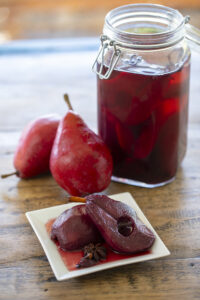
Ingredients
- 3 cups or 1 bottle red wine
- ⅔ cup sugar
- 1 cinnamon stick
- 6 black peppercorns
- 3 star anise pods
- 3 cardamom pods
- 3 cloves
- Pinch of grated nutmeg
- Pinch of salt
- 4 large pears
Instructions
- In a pot large enough to hold the pears, add wine, sugar, spices, and salt. Bring to a boil over medium heat.
- Meanwhile, peel and cut the pears in half. Using a melon baller, scoop out the core. With a small paring knife, remove the inner part of the stalk, leaving the outer stem intact.
- Add the pears to the pot and lower the heat. They should be covered with cooking liquid.
- Cover and poach gently for 10 to 15 minutes, turning them over occasionally to make sure they color evenly. If desired, you can place a circle of parchment paper on top of the syrup to make sure the pears remain beneath the liquid. Simmer until pears are soft when pierced with a knife.
- Drain and transfer pears to a serving dish or container. If you like a heavier syrup, reduce it until lightly thickened.
- Combine pears with syrup and allow to cool before serving. Pears will keep refrigerated up to a week.
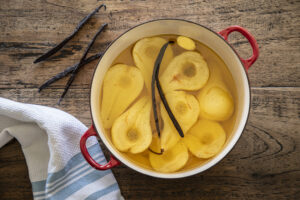
Ingredients
- 3 cups or 1 bottle white wine
- ⅔ cup sugar
- 1 pinch saffron
- 2 slices peeled ginger
- 1 vanilla bean split
- 1 pinch salt
- 4 pears preferably Bosc
Instructions
- In a pot large enough to hold the pears, add wine, sugar, saffron, ginger, vanilla bean, and salt. Bring to a boil over medium heat.
- Meanwhile, peel and cut pears in half. Using a melon baller, scoop out the core. With a small paring knife, remove the inner part of the stalk, leaving the outer stem intact.
- Add pears and lower heat. They should be covered with cooking liquid. Cover and poach gently for 10 to 15 minutes, turning them over occasionally to make sure they color evenly. If desired, you can place a circle of parchment paper on top of the syrup to make sure the pears remain beneath the liquid. Simmer until pears are soft when pierced with a knife.
- Drain and transfer pears to a serving dish or container. If you like a heavier syrup, reduce it until lightly thickened.
- Combine pears with syrup and allow to cool before serving. Pears will keep refrigerated up to a week.
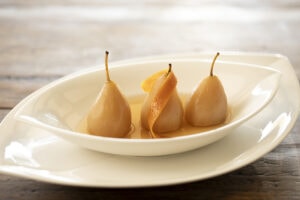
Ingredients
- 8 forelles or any other small pears
- 2 cups water
- ⅔ cup sugar
- 1 piece of orange zest
- 1 cup brandy or Cognac
Instructions
- Peel the pears and, using a small paring knife, remove the blossom end but keep the pears whole.
- In a pot large enough to hold the pears snugly, heat the water, sugar, and zest.
- Once it boils, lower heat, add pears, cover, and simmer gently for 15 minutes or until pears are soft when pierced with a knife. Add Cognac and cook for 3 minutes, to allow the alcohol to evaporate. Cool before serving.
More From This Issue
Behind the Brews
The Biggest Little City is home to an impressive number of craft breweries where you can casually sip your favorite…Amazing Alliums
Latin for garlic, Allium is a genus of foods that extend beyond garlic to include onions, shallots, leeks, and chives…