
Taming of the Brew
Reno’s beer history began on Fourth Street.
East Fourth Street, one of Reno’s most historic thoroughfares, defies definition. It’s a section of the old Lincoln Highway, once studded with adorable motor courts. The area once overloaded the senses with clanging streetcars, ironworks, and the stench of rendering plants. But the street also has a deeply rooted legacy as Reno’s Brewery District, a term used more for marketing than an official designation. The zone loosely stretched from Evans Avenue to Sutro Street, and its location adjacent to the railroad tracks made it an ideal hub for shipping supplies in and products out to market.
Reno Brewing Co.
The area’s reputation began when Reno Brewing Co. opened in 1903 on the corner of East Fourth and Spokane streets. Other breweries existed elsewhere in Reno, including the Buffalo Brewing Co., Riter’s Elite Steam Beer, and the Wieland Brewing Co.
The masterminds behind the new enterprise were a trio of young men, master brewer Jacob Hook and partners John Maurer and Peter Dohr. The original cost to build the plant was $40,000, and the corn, malt, and hops needed for brewing were brought by rail. The brewery operated a modern, electricity-powered ice plant that chilled the barrels.
Local newspapers were filled with updates on the construction of the building and opening-day festivities. The first brew was dubbed Sierra Lager, and 600 barrels were ready when the doors were unlocked. The company proudly stated that the beer was produced by members of the Brewers’ Union and that it contained 3.5 percent alcohol — “just enough to aid digestion.” A headline in the Evening Gazette rejoiced, “Reno need no longer send East for lager.”
Saloons quickly switched to the local choice, with the Reno Evening Gazette proclaiming, “The new brewery opens another door to the possibilities of Nevada.” After early success, the business’ owners announced plans to open bottle works and contemplated the addition of a malthouse, even encouraging local farmers to grow barley. By 1907, it was the largest brewery in Nevada. It boasted a new five-story brick annex and expanded its production to three varieties of beer: Sierra Beer, Malt Rose, and Royal Lager.
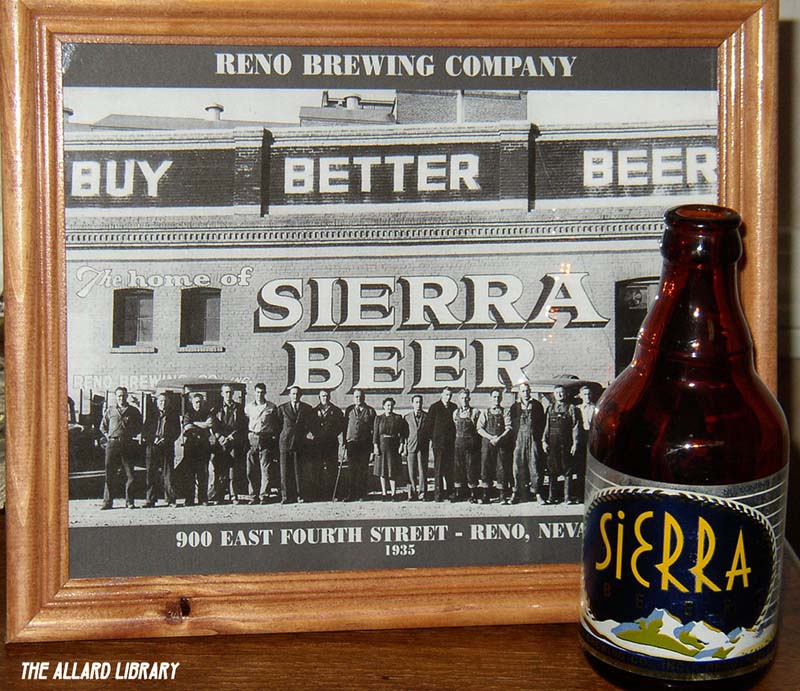
Prohibition left its mark, and national brands such as Anheuser-Busch began to dominate the industry. The company stopped brewing in 1957, the assets were sold, and the brewery building was demolished in 1959, reportedly to make way for a projected casino that was never built. The adjacent bottling plant, built in 1940, remains empty, with many unrealized uses suggested through the years.
Rainier Brewing Offers Competition
What’s in a name? If your current name is the Spice House Adult Cabaret, it’s a long history. It once was the Ice House Restaurant and Ice House Antiques — and before that, the Rainier Brewing Co. Bottling Plant. In 1905, Seattle-based Rainier built a bottling works and distribution center at 310 Spokane St., just south of East Fourth Street, along the railroad tracks. The structure required a sizeable investment of $30,000 (equivalent to more than $1 million today). The beer was shipped from Seattle via railroad and unloaded into a bottling complex with cold, keg, and barrel storage. There even were stables for the delivery-wagon horses. After Prohibition, the Rainier plant housed several businesses. The bones of the building remain, and it was added to the National Register of Historic Places in 1980.

Prohibition Changes Everything
It’s interesting to consider what East Fourth Street would look like today if Prohibition didn’t descend on the nation in 1919, with major impacts on area brewers. The expansion of the breweries came to a halt, and they were forced to shift production. Unlike many of the state’s other breweries, which shut down permanently during Prohibition, the Reno Brewing Co.’s owners cleverly redirected its equipment to the manufacture of “near beer,” tonic, seltzers, and soft drinks. With the repeal of Prohibition in 1933, demand for the company’s beer soared higher than ever.
Rainier survived national Prohibition but also was forced to diversify its products. Its offerings included nonalcoholic beverages such as Rainier’s Near Beer, Brown’s Celery Phosphate, carbonated apple juice, and maple syrup. The company also rented out storage space for refrigerated and nonrefrigerated food items.
Urban life has a cyclical nature. The pioneering breweries are gone, but the area again is home to others that no one would have predicted 100 years ago. The modern brewery district features The Depot Craft Brewery & Distillery, Lake Tahoe AleWorx, and Lead Dog Brewing on Fourth Street. And Pigeon Head Brewery is on nearby Fifth Street, as is Battle Born Beer, and Slieve Brewing Co. is close to Fourth Street on Morrill Avenue. And, while not beer, the folks at Black Rabbit Mead Co. are brewing mead on Fourth Street. Apparently, when it comes to Reno’s brewery district, what’s old is new again.
RESOURCES
For details about the businesses mentioned here, and other Reno history, visit Renohistorical.org or download the Reno Historical app, managed by the Historic Reno Preservation Society.
More From This Issue
The Last Sip
Affogato: A delicious Italian dessert made by pouring fresh espresso over vanilla ice cream or gelato.Wedding Guide
Celebrating dream vendors in the Reno-Tahoe area.Home Guide
Make 2026 your home’s best year ever. These upgrades, both big and small, will make you want to stay home…